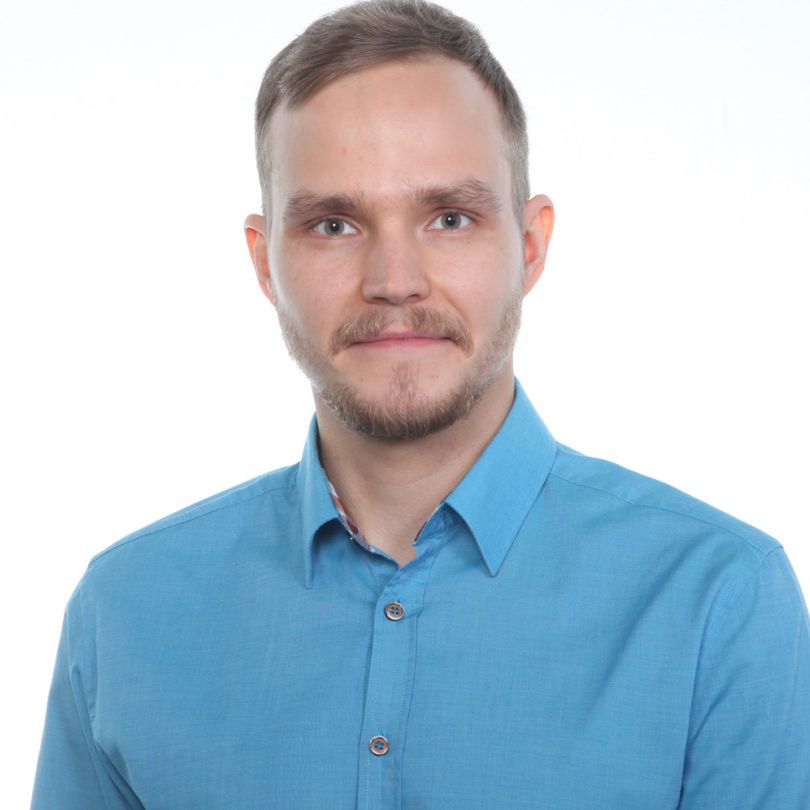
Homepage

Research in inverse problems and theoretical particle physics
I develop mathematical methods for extracting the structure of strongly interacting matter from experimental data. My research combines inverse problems, uncertainty quantification, and quantum chromodynamics (QCD), with a particular focus on parameterization-independent reconstruction of hadronic structure from scattering measurements.
Current position: Postdoctoral Researcher, University of Jyväskylä
Research areas: Inverse Problems • Mathematical Physics • Quantum Chromodynamics • Data Reconstruction • Uncertainty Quantification
Research Vision
Experimental measurements provide only indirect access to the fundamental structure of matter. My long-term goal is to develop a mathematically rigorous framework for reconstructing physical observables directly from experimental data while quantifying the associated uncertainties.
This programme combines:
- inverse problems,
- linear and nonlinear integral equations,
- uncertainty quantification,
- theoretical and phenomenological particle physics,
- quantum chromodynamics.
By connecting modern inverse-problem methodology with high-energy physics, I aim to open new avenues for extracting information from current and future particle-physics experiments.
Research Highlights
Parameterization-Independent Reconstruction in QCD Developing inverse-problem methods for reconstructing dipole amplitudes directly from deep inelastic scattering data without relying on restrictive model ansätze.
Mathematical Inverse Problems in High-Energy Physics Understanding and leveraging the mathematical structure how the to-be-inferred quantity is related to the experimental observables open paths to new tailored methods.
Theory and Computation Combining rigorous mathematical analysis with computational methods to address challenging nonlinear reconstruction problems arising in particle physics.
Selected Publications
Mathematical inverse problem for the world data inference of the parton distribution functions of the proton
Under review, 2026
Contribution. Constructed a mathematical inverse-problem formulation for the extraction of the proton PDFs without a fitting ansatz from DIS world data.
Significance. Opens a path towards parametrization-bias-free extraction of the parton distribution functions of the proton.
Reconstruction of the Dipole Amplitude in the Dipole Picture as a mathematical Inverse Problem
Phys. Rev. D, 2025
Contribution. Introduced an inverse-problem formulation for the reconstruction of the dipole amplitude from deep inelastic scattering data.
Significance. Demonstrated how mathematical reconstruction techniques can reduce parameterization bias in small-x QCD analyses.
Scientific Communication
I am highly interested in exploring the use of visual media in the communication of state-of-the-art research. I explore these ideas and topics in the Blog and Portfolio sections of these pages.
Short Biography
I began my bachelor’s studies at the University of Jyväskylä in 2012 in the accelerated study program of physics, where the first 1.5 years of basic courses were condensed into 3 months, which was quite an intense experience. Of course with my love of mathematics and overly ambitious peers in the programme, on top of the physics course we took the same analysis courses that mainline mathematics students started with. We were quite whelmed. I got my Bachelor’s in 2.5 years, and moved on to the theoretically oriented Master’s programme in physics, which I finished in 2017.
At this point I had a bit of a pause in momentum and a sense of uncertainty in my plans. Most of my close friends had moved from theoretical physics to pure mathematics, which lead me to consider a PhD in mathematics at this point. I ended up following my heart and sticking with theoretical particle physics, and completed my thesis in 2021 after getting two children, with a third on the way. Following my defense I was able to stay for a year as a postdoc to finish two interesting projects in the particle physics group, after which I happily stumbled on the opportunity to join the Inverse Problems and mathematical physics group of Prof. Joonas Ilmavirta, which I believe has opened completely new horizons combining mathematics and theoretical physics.